
Rural free
The Healing Land.

Words by Shawn and Beth Dougherty
Rural Free
The longer we work this land, the more deeply it forms the way we live and think. We build gardens and homes, fences and barns; we pasture cows, sheep, and poultry; we plant and tend gardens. And yet, in the long run, it is we, not the natural world, who are changed the most profoundly. Our visible impact on the land, the plants, and the animals signals a much more profound alteration inside us, the land keepers. We are the students, and winter and summer, the farm gives us glimpses of who God is, and our true place in His creation.
Neighbors
January has been the time for our community pig harvest for twenty years. Our neighbors Barry and Kathy began it, with equipment Barry inherited from his father, and knowledge he acquired over a lifetime. It is no surprise to find these friends at the heart of any community activity; their family is always reaching out to share – food, time, knowledge – with the folks nearest them.
The connection between our families is natural. Our farms are only a couple of miles apart by the road. Barry had equipment and know-how; we had sons. He asked if we wanted to learn to slaughter pigs. With Barry supplying the brains and the Dougherty boys the brawn, his garage was transformed into a butcher shop. We built a brick stove to accommodate two cast iron kettles. We hung a block and tackle from the reinforced rafters in Barry’s barn, to carry the weight of several hogs. The long wooden scalding trough and maple harvest table took up their places against the wall under a row of iron meathooks and singletrees of various sizes. Five weanling pigs moved into a tidy pen in the barn.
That summer and fall, we were up and down the hill to Barry’s every day or so. We carried buckets of kitchen scraps to feed our new charges, bushels of garden wastes and corn shucks, gallons of tomato peels and apple cores from our food preservation tasks. Skim milk and buttermilk were welcomed enthusiastically by our fast-growing porkers. Our families took turns cleaning out the pig pen, keeping the water trough full. The pigs grew big, and then bigger.
Patterns
When January came, we got our first lesson in large-animal harvest. That winter, Barry taught us to butcher hogs; we’ve held a January hog butchering ever since. Long custom passed down to our children has given our work a set pattern, a predictable schedule; you could almost say a ritual.
On Thursday evening, the men–who have eaten an early dinner–gather about five o’clock in Barry’s big barn. By eight, there are three hogs hanging from the rafters; there, they will cool until the meat is firm enough for cutting. Nothing else can be done tonight, so everyone goes home to grab as much sleep as possible before an early morning start and a busy day.
Friday, business gets underway as soon as it’s light, the frosty air crisp with a sense of festival exertion. Breakfasts eaten hastily at home will be made up for in a couple of hours when hot coffee and cinnamon rolls are brought out from the farmhouse kitchen. Right now, though, all is business. As the heavy sides are taken down from their hooks, the children – today this is a new crop of young ones, the children of the original children – stand to one side, sorting through a collection of butchering knives, looking for familiar favorites. These are the up-and-coming butchers, learning their trade from their elders. At the moment, their toes are cold, even through two pairs of socks, and they jostle and shiver; at lunchtime, they’ll run sleds down the hill while the men eat their meal.
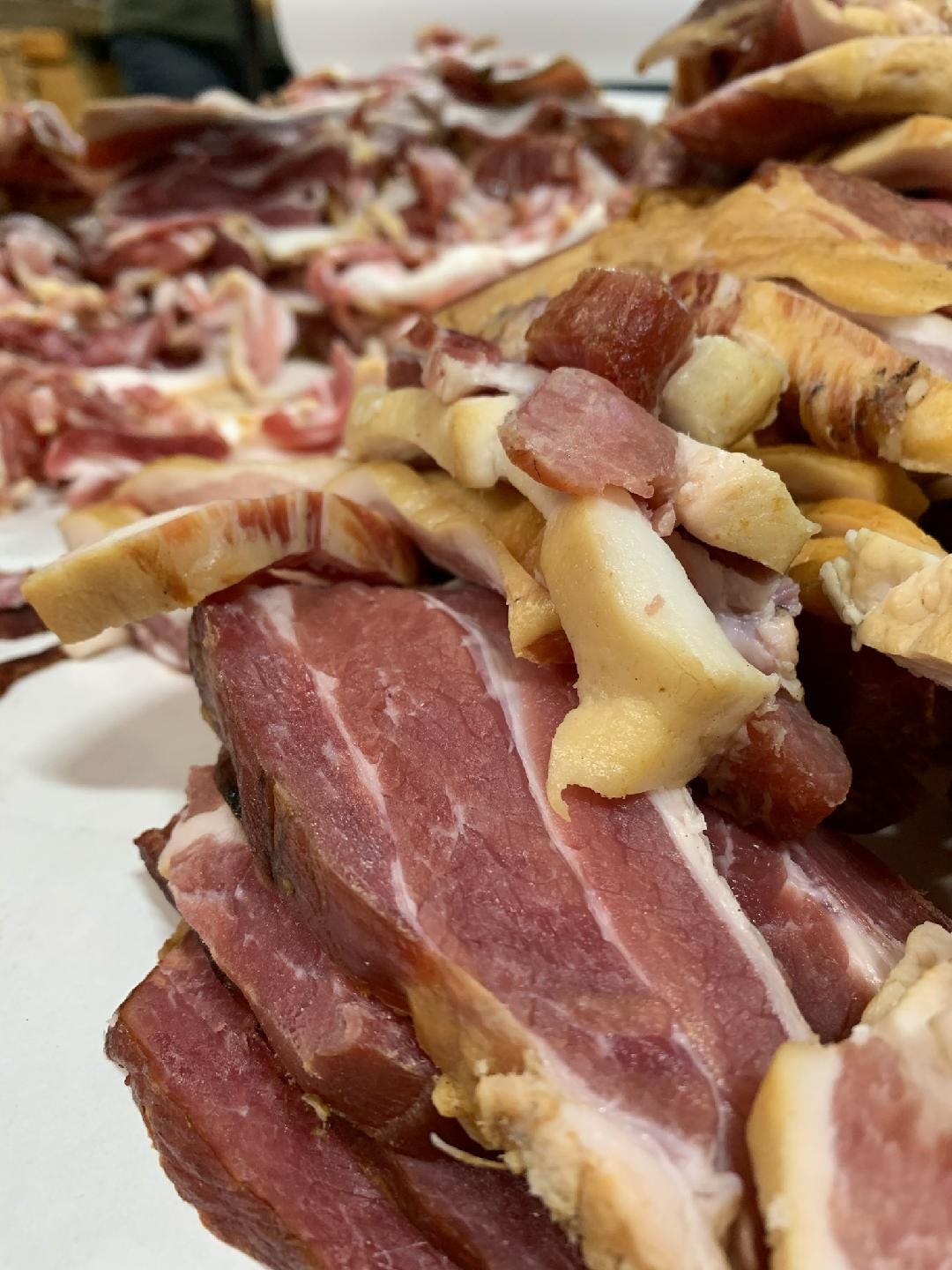
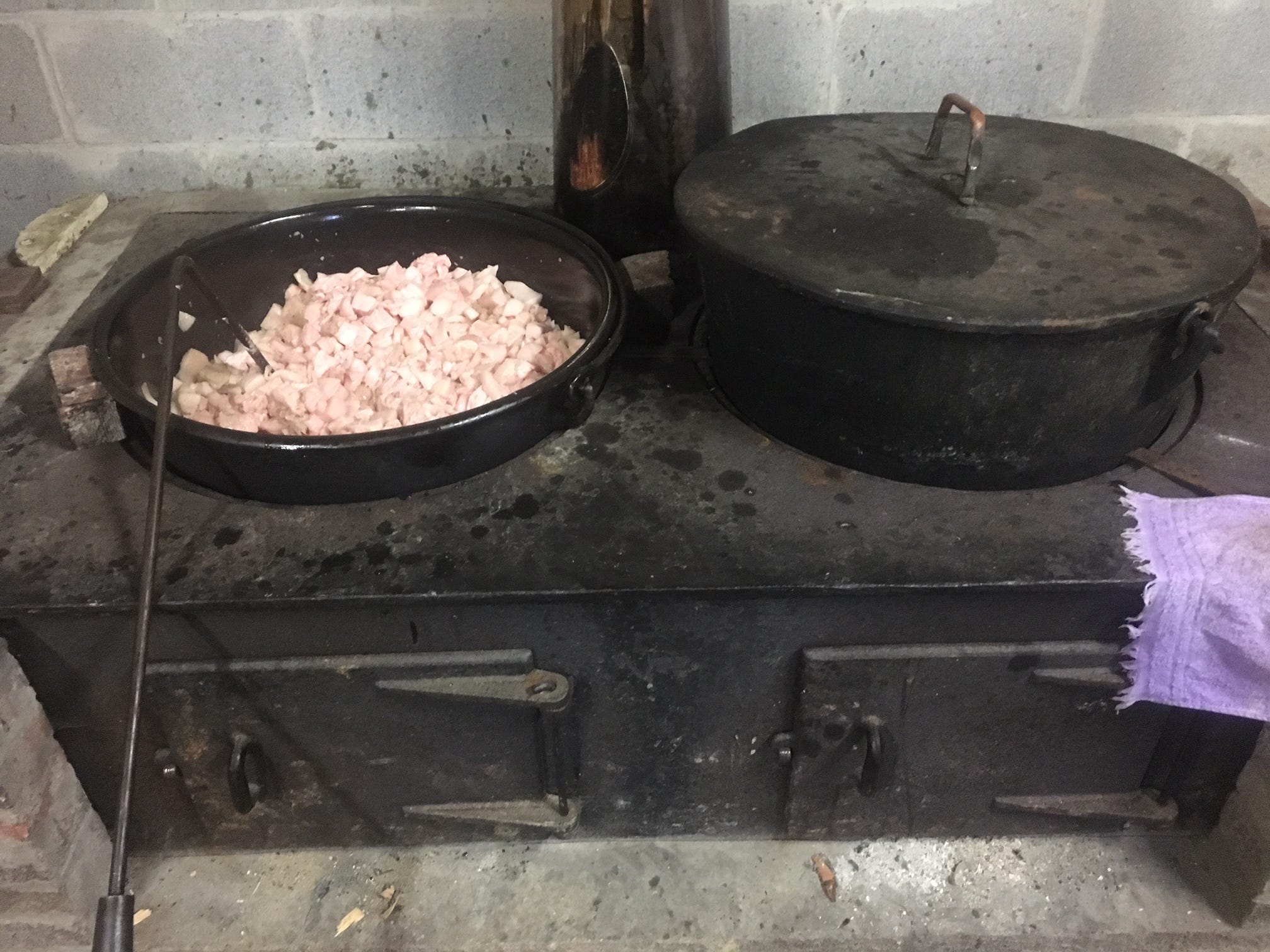
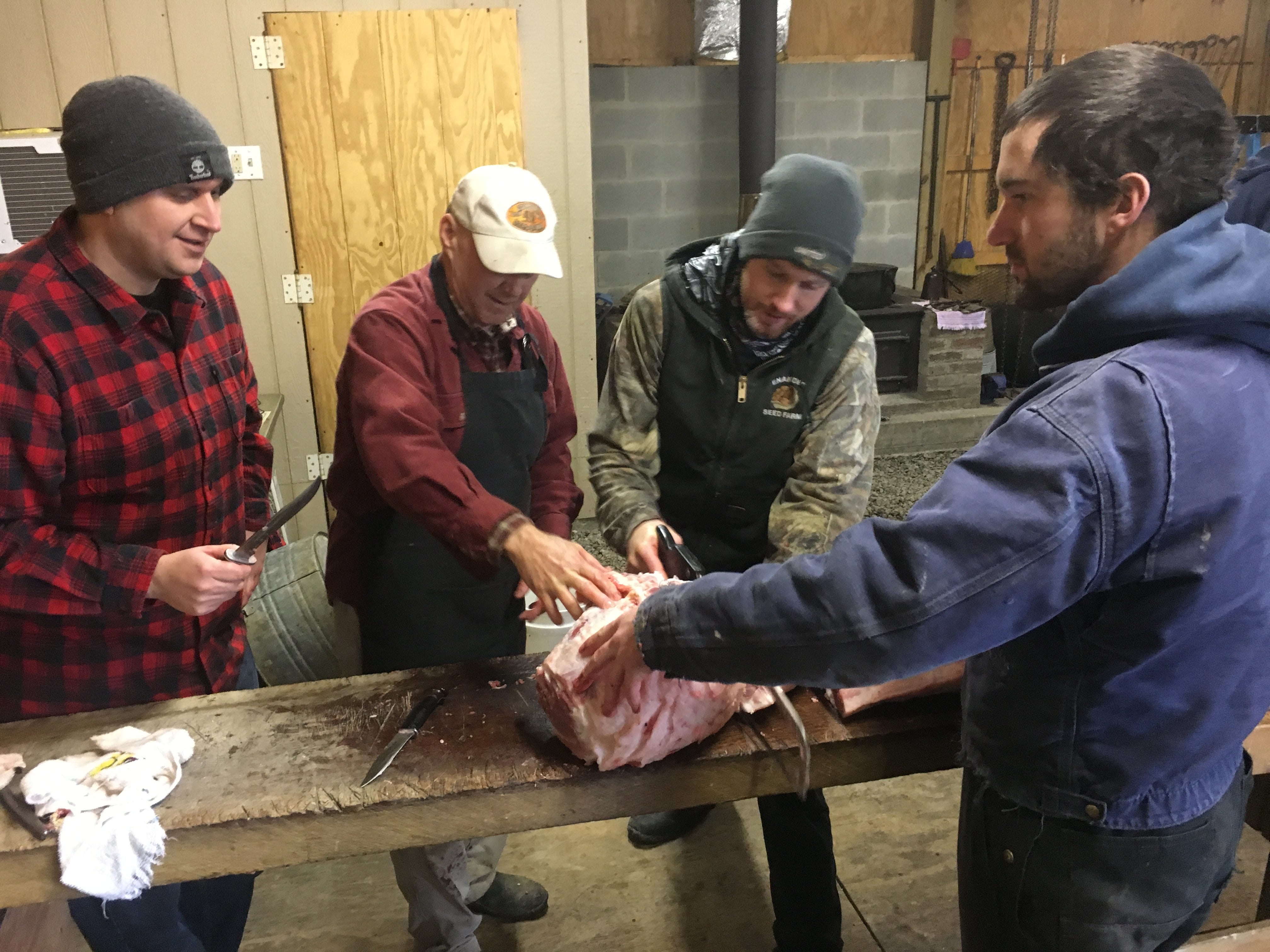
Everyone knows the business. Knives flash, saws buzz, and in a short time, the two long harvest tables – one is a split maple trunk on legs, a foot thick and two feet wide – disappear under layers of chops, bellies, and racks of ribs. Huge hams and shoulders stand up like small mountain ranges; neat stacks of hocks are ricked like firewood. On the big stove, two cauldrons are heating, one of steaming water, the other ready to receive ground fat to be rendered into lard.
At the second table, children line up alongside a mound of bones, their job being to cut trimmings into chunks for the grinder. Buckets at their feet will fill with scraps, lean meat for sausage, some of the fat for the lard kettle. As fast as the children process one pile, another appears, but with so much help, the job moves quickly.
Taking it all apart
In a few hours, the men have all six sides broken down into primal parts, and the work of piecing, sorting, and wrapping begins. Lard is simmering in the big iron kettle. The children have stood down both sides of the long butchering table, cutting meat for sausage, exchanging things: knives to be sharpened, good-natured insults, well-worn jokes. Lunch is plentiful and festive but hasty; all the cuts must be wrapped and labeled by dinner, because two more hogs still wait in the barn. Tomorrow we’ll process these as well. Then we’ll grind and season sausage, salt bacons and hams. If we finish early, there will be time for sledding before the big harvest supper that proclaims the end of our labors, the gratitude for these gifts. This year’s annual community pig slaughter will be over.
Putting it together
Old friends though we are now, we’d be hard-pressed to explain what originally drew us together. Church, maybe, but lots of other folks go to our church. Neighborhood, yes, but there are other neighbors, many, who don’t raise pigs with us. Maybe it’s farming that really draws us into an identifiable community: the lessons of taking food from the land, gardening, tending animals, and food preservation. Seeing ourselves fed directly from the generosity of God, and knowing we have to cooperate if we are to enjoy His generosity – maybe these things give us an alignment of vision, a similar viewpoint, a mutual understanding.
On the farm, education, like community, happens without thought, even without reflection. So many different tasks are required just to meet day-to-day necessities, and no one is exempt. The children have grown up knowing no other way of putting meat on the table, and today they are experienced butchers. Today’s adults, who not-so-long-ago were the children, are now the ones who use the rifle and skinning knife, and we of the older generation marvel at their speed and skill.
Whatever the glue is, this is Neighborhood. Being home folks, we learn from those closest to us. We have to make our celebrations happen here, where we live; and that means with other folks of Here, too. Festivals just naturally spring up around work and harvest, haymaking and bonfire, and hog slaughter and good food. These things are our response to the needs of our physical place, these hills where we have settled, and – we all know deeply – they are how we are fed and made whole.